
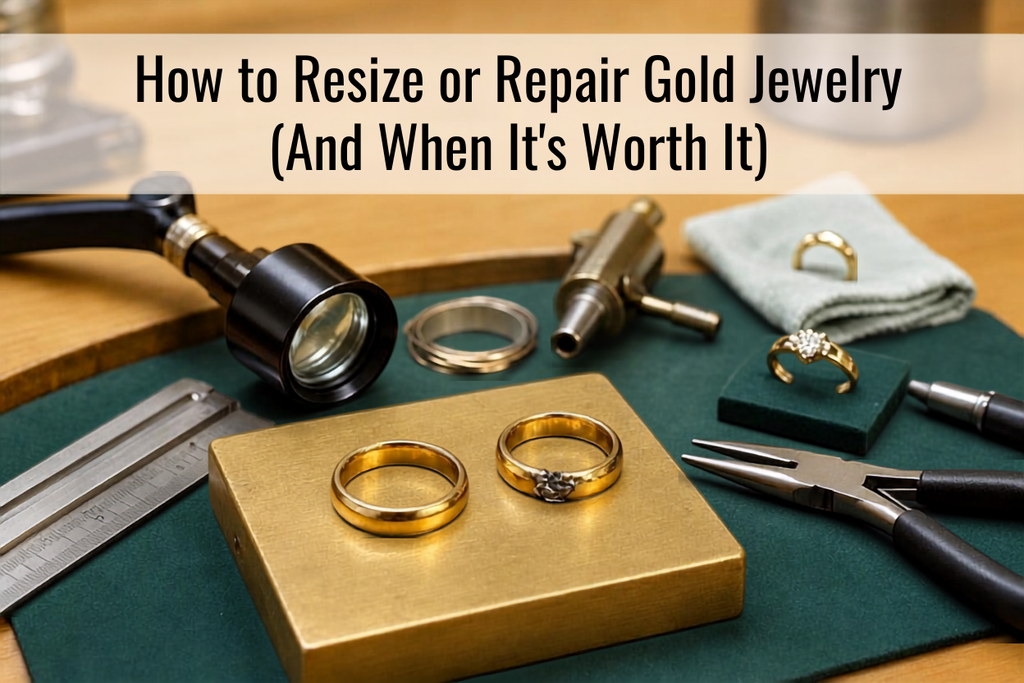
You can usually resize gold jewelry rather than replace it. A ring that spins on your finger or a chain that snapped mid-week doesn’t have to sit in a drawer forever. Most gold jewelry can be resized or repaired, and because gold holds real material value, the work is often cheaper than replacing the piece. Here’s what a jeweller actually does, which repairs are straightforward, which ones aren’t, and how to decide whether the cost makes sense.
How Gold Resizing Actually Works
Resizing a ring is a metalwork job, not an adjustment. There are two basic directions.
Sizing down means the jeweller cuts a small section out of the bottom of the band, brings the two ends together, and solders the joint closed. The seam is then filed, polished, and — if the piece is white gold — usually re-plated with rhodium so the repair blends in.
Sizing up is done one of two ways. For small increases, the band can be stretched on a mandrel, which thins the metal slightly. For larger increases, the jeweller cuts the band and solders in a matching piece of gold, then finishes it the same way.
A clean resize on a plain band is usually invisible once it’s polished. The more detail there is around the band, the more visible the intervention becomes.
How Much a Resize Can Change
As a rough guide, most jewellers are comfortable moving a plain gold band one to two sizes in either direction. Beyond that, the proportions start to suffer — a band sized up too far gets thin at the bottom, and a band sized down too far can end up with a noticeably heavier base.
If you need three or more sizes of change, ask about remaking the band instead. It costs more upfront, but you keep the setting and stones and end up with a piece that wears properly rather than one that’s been pushed past its limits.
The Repairs That Are Usually Simple
These jobs are routine for any competent bench jeweller:
- Broken chain links — reconnected and soldered, often near-invisible on a plain chain.
- Worn or broken clasps — typically replaced rather than repaired, since a new clasp is inexpensive and more reliable.
- Tightening loose stones — re-tipping or re-forming prongs before a stone falls out. Worth doing early.
- Ring reshaping — a band bent into an oval can usually be trued back to round.
- Re-plating white gold — rhodium plating wears off over time and can be reapplied.
- Polishing out surface scratches — light polishing removes a very small amount of metal and restores the finish.

Before booking a repair, it’s worth checking whether the problem is actually just dirt or a stretched clasp ring. A simple loupe and a soft brush will tell you a lot in five minutes. Shop jeweller’s loupes and soft cleaning brushes on Amazon.
The Repairs That Get Complicated
Some jobs are possible but need a specialist — and a conversation about cost before anyone starts.
Eternity rings and full-pavé bands
Stones run the whole way around, so there’s no plain section to cut. Resizing usually means resetting stones or remaking the band.
Engraving, hallmarks, or channel work at the base
Cutting through pattern or lettering means it has to be recut by hand afterwards, and it rarely matches perfectly.
Tension settings
The stone is held by the spring pressure of the metal itself. Change the diameter and you change that pressure, which is why many tension rings can’t be resized at all.
Heat-sensitive stones
Soldering involves heat, and emerald, opal, pearl, tanzanite, and some treated stones can crack or discolour. A good jeweller will remove the stones first, which adds labour.
Mixed metals and hollow pieces
Gold sections of a mixed-metal piece can often be worked, while titanium and tungsten frequently cannot. Hollow chains and hollow bangles are thin-walled and prone to collapsing or burning through under a torch — repairs are possible but less durable than on solid pieces.
When It’s Worth Repairing — And When It Isn’t
There’s no universal price list; rates vary by country, by jeweller, and by karat. But the decision usually comes down to four questions.
What’s the piece worth to you beyond the gold? Sentimental pieces, heirlooms, and engagement rings are almost always worth repairing. There’s no replacement.
How does the quote compare to the piece’s value? A useful rule of thumb: if the repair quote approaches half of what an equivalent new piece would cost, pause and compare properly. Ask for the quote in writing before agreeing.
Is it solid gold or plated? This is often the deciding factor. Solid gold takes solder and polish well and can be worked on repeatedly. Gold-plated pieces are a different story — soldering burns through the plating, and re-plating a thin layer over a base metal core is rarely worth the labour. If a plated chain breaks, replacing it is usually the sensible move.
Will it fail again in the same place? A chain that has broken three times in different links is telling you the gauge is too light for how you wear it. Repairing it a fourth time is money spent on a design mismatch, not on damage.
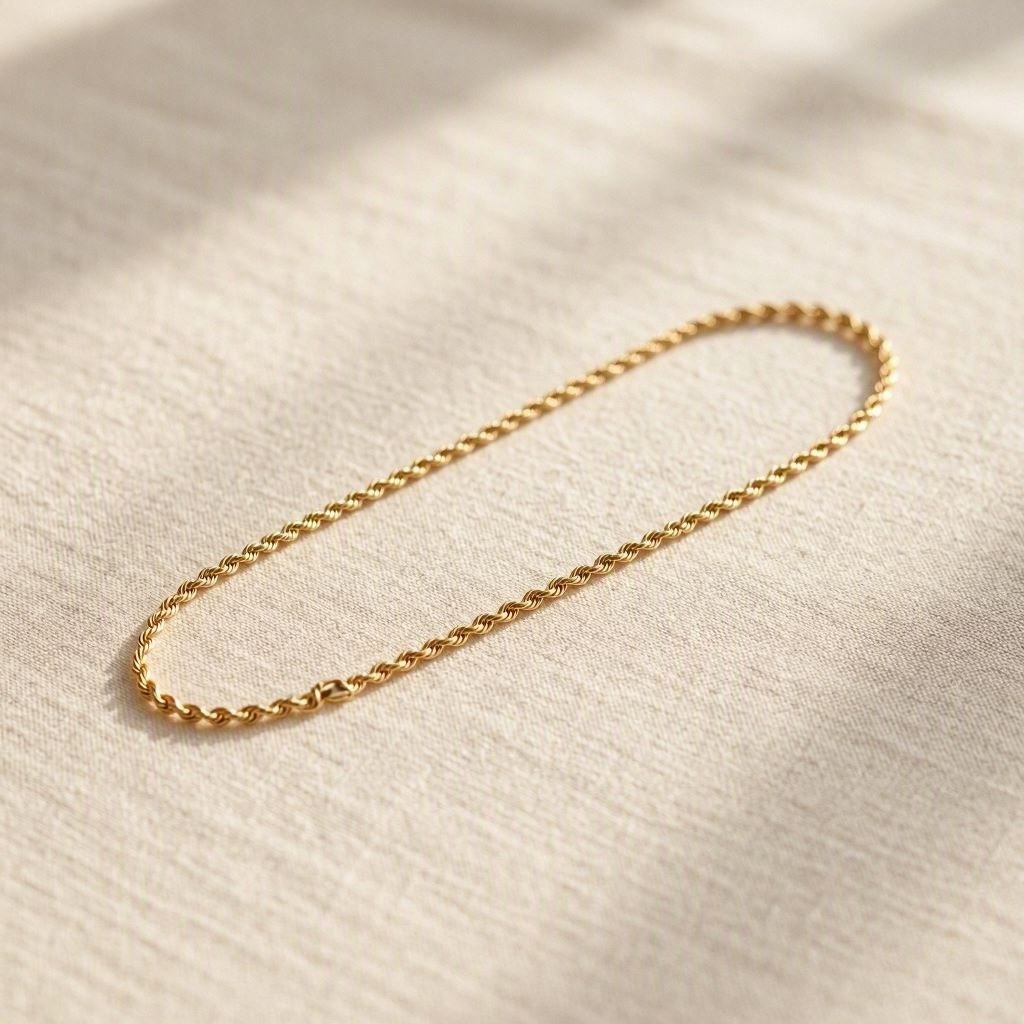
When a plated piece isn’t worth repairing, moving to solid gold usually ends the cycle. Browse gold chains and bracelets on Amazon if you want something built for long-term wear.
Choosing Someone to Do the Work
Repairs are only as good as the bench they’re done on. A few things worth checking:
- Ask whether the work is done in-house or sent out. Neither is wrong, but in-house usually means faster turnaround and clearer accountability.
- Ask for a written quote and a description of the method — cut and solder, stretch, or remake.
- Ask what happens to the stones. Any piece with stones should be logged in and inspected before and after.
- Get a receipt that describes the piece, including karat, stone count, and any existing damage.
- Ask about warranty on the repair itself.
Independent bench jewellers are often better value than chain retailers for this kind of work, since the repair is their trade rather than an add-on service.
Preventing the Next Repair
Most repairs trace back to a handful of habits. Take rings off for the gym, heavy lifting, and gardening — a single hard knock does more damage than years of normal wear. Clasp your necklaces rather than pulling them over your head, which stresses the same links repeatedly. Store chains flat or hung instead of tangled in a pile. And have prongs checked once a year on any piece with stones; re-tipping a worn prong costs a fraction of replacing a lost stone.
FAQ
How much does it cost to resize gold jewelry?
Costs depend on karat, how many sizes you’re moving, and whether stones need removing — so always get a written quote first. As a general pattern, a plain band resized one size is one of the cheapest bench jobs, while eternity bands, engraved rings, and pieces with heat-sensitive stones cost considerably more because they involve resetting or remaking.
Can all gold rings be resized?
No. Eternity and full-pavé bands, tension settings, and rings with detail running around the entire base often can’t be resized conventionally — they need remaking or a sizing insert instead. Hollow and plated pieces are also poor candidates. A jeweller can tell you within a minute of looking at the piece.
Does resizing weaken a gold ring?
A properly soldered resize is structurally sound and the joint is generally as strong as the surrounding metal. Repeated resizing and heavy stretching are what cause problems, since both thin the band. If a ring has already been resized more than once, mention it — it changes how the jeweller approaches the job.
Gold’s real advantage is that it stays workable: a piece that fits badly or breaks is usually a repair away from being wearable again, not a write-off. For more on keeping your pieces in good shape between visits, browse our Care & Authenticity guides, and if you’re weighing a repair against a replacement, Buying Guides can help you compare what a new piece would actually cost.
Looking to shop? Browse Amazon’s best-selling women’s jewelry.